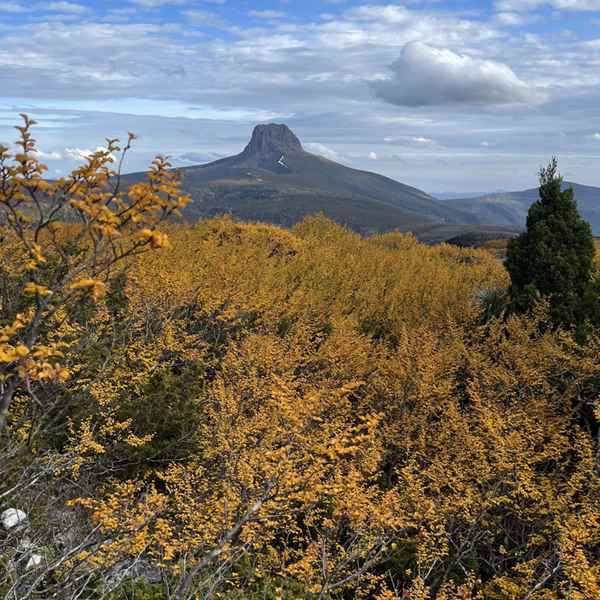
A Mountain in Glow: Walking the Overland Track During the Turning of the Fagus
There is a moment, during Autumn, when Tasmania's highlands do something extraordinary. The mountain slopes, grey and green for most of the year and occasionally white, suddenly ignite. Deep rust, burnt orange, lemon yellow, and molten gold sweep across the high country like a slow-moving tide. Tasmanians have a name for it: the Turning of the Fagus.
For walkers on the Tasmanian Walking Company's Overland Track, this moment doesn't arrive as a postcard. It arrives as something immersive, surrounding, and impossible to fully appreciate through a picture (even though we have some fantastic ones). Read on for some on the ground stories from Overland guide, Mahalia Smith (and some of her own photos) and bit a of a history of our beloved fagus.

A Tree Unlike Any Other
The fagus (Nothofagus gunnii), also known as deciduous beech or "tanglefoot" holds a rare distinction. It is Australia's only cold-climate native deciduous tree. You won't find it on the mainland. You won't find it anywhere else on Earth. It grows only in Tasmania, only above 800 metres, in cool wet highland pockets where frost is common and the sky feels close. Less than 11,000 hectares of it exist in the world.
To walk through it is to walk through deep time. The fagus is a Gondwanan survivor, a living relic from the ancient supercontinent that once connected Tasmania, South America, New Zealand and Antarctica. Fossil records of its ancestors, dated to 35 million years old, have been found in Antarctica. It often grows alongside pencil pines, another species that hasn't meaningfully evolved in 35 million years. Standing among them is like looking back to an era when dinosaurs roamed the southern continent. The word "ancient" feels slightly insufficient.

The Turning Itself
As daylight fades and overnight frosts deepen, the fagus begins breaking down its chlorophyll. A compound called anthocyanin takes over, and the tree announces itself in flamboyant style, moving slowly from lemon yellow through soft orange, and, if the frosts bite hard enough, into a deep burning red before the leaves finally fall and return their minerals to the soil.
The peak tends to fall around Anzac Day, typically April 25th, and the colour holds for close to a month. But as Tasmanian Walking Company Overland guide Mahalia knows well, photographs only tell part of the story. “One thing a camera can't quite capture is just how vibrant the colours are and how they contrast so beautifully with the rest of the landscape. There's also such a special feeling actually walking through it and being surrounded by it. It's definitely something to be experienced in person." 
A Season Seen in Full
Most visitors catch the fagus at a single point in time, a weekend walk, a lucky afternoon. That's beautiful. But it's only a chapter. Walking guides on the Overland Track see something richer, present week after week as the transformation unfolds. For our guides, like Mahalia, they get to see it all. “It's super special because we get to be there for the whole cycle,” says Mahalia. From bare winter branches, through tiny green buds, through to full summer growth, and then, slowly and unmistakably, the shift into colour. “My personal favourite stage is when it's in the deep orange and red phase — when the landscape looks like it's on fire with colour,” she says.
A Place to Stop
Fagus appears throughout the Overland Track during autumn, but Mahalia has one favourite spot to take it all in. On Day four, as the trail climbs to the Japanese Gardens below Mount Doris, a sculpted, moss-covered alpine landscape of quiet extraordinary beauty. It's here, with tea in hand and the surrounding peaks rising in every direction, that the turning feels most complete, and for Mahlia, Day four is the best part. 
Walk It With an Expert
For those who want to go deeper, the Tasmanian Walking Company's Cradle Mountain 'Turning of the Fagus' Walk is a seven-day limited edition journey across the Overland Track timed specifically for the turning. Guests walk with an expert Tasmanian botanist, exploring the ecology of the alpine flora at its most dramatic.
Each evening is spent in the company's private huts, the only private accommodation on the Overland Track, unwinding with botanical sketching sessions, Tasmanian wines, and the kind of conversation that only happens after a long day in extraordinary country. The turning peaks around Anzac Day and the window is short. The fagus waits for no one.

Feeling inspired to walk through history? Don’t miss the brief, brilliant window of the fagus. Join us in 2027 for a specialized 7-day trek, the Cradle Mountain 'Turning of the Fagus' Walk. With our private huts as your base and an expert botanist as your guide, you’ll experience the "Turning" with a depth and comfort found nowhere else.
Last updated 13 May 2026.